Hormones and Weight Loss Resistance: Why the Scale Won't Budge | Primary Wellness NY
Hormones and Weight Loss Resistance: Why the Scale Won't Budge
Quick Answer
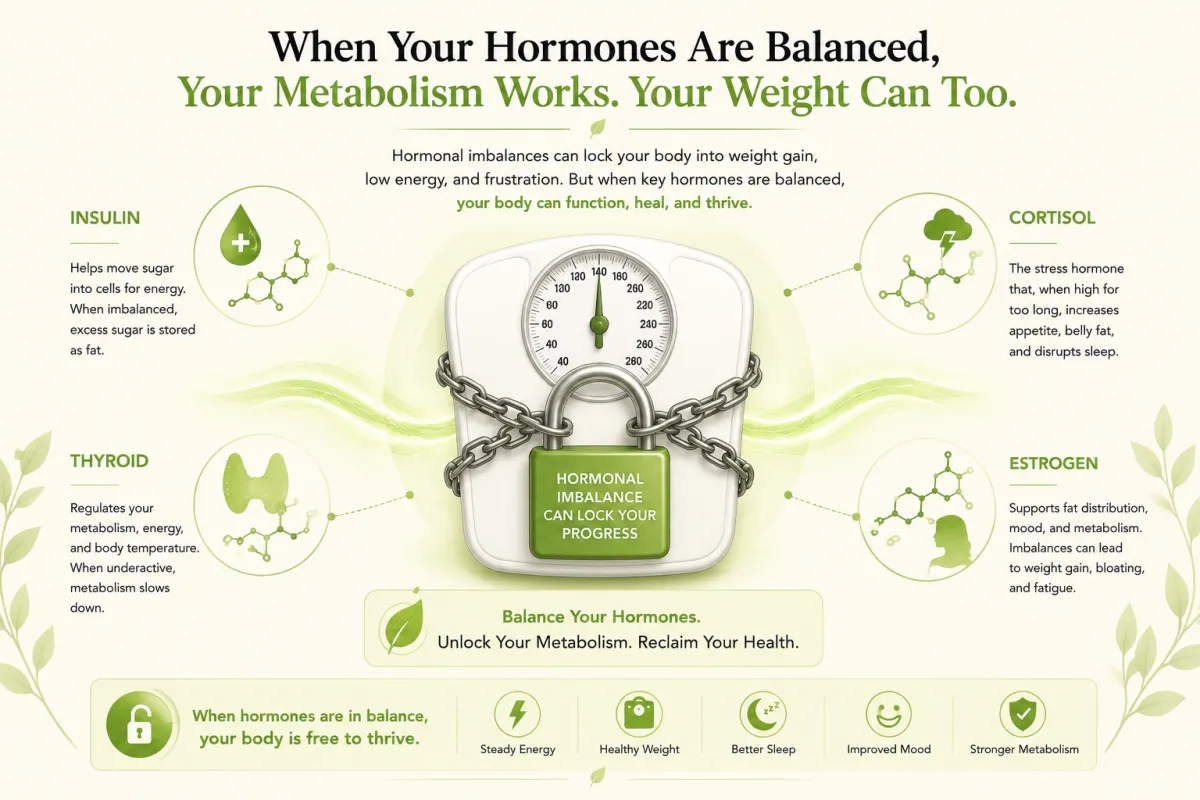
If you are eating well, exercising, and the scale still will not move, hormones are often the hidden factor. The primary hormonal drivers of weight loss resistance are insulin, which acts as a fat-storage hormone when levels are chronically elevated; cortisol, the stress hormone that promotes belly fat storage; thyroid hormone, which regulates metabolic rate; and sex hormones like estrogen, progesterone, and testosterone, which shift with age and affect fat distribution and metabolism. When these hormones are out of balance, even the cleanest diet can fail to produce results . The good news is that these imbalances are identifiable and treatable with the right medical evaluation.
Introduction
You follow all the rules. You eat the right foods. You exercise regularly. You count calories. And yet, the scale refuses to budge. This is one of the most common and frustrating experiences in weight management, and it has a name: weight loss resistance.
The reality is that for many people, the problem is not a lack of discipline or willpower. It is that their hormones are working against them . Weight loss resistance is often driven by hormonal and metabolic dysregulation. Understanding these "hormonal speed bumps" is critical to breaking through a plateau and regaining control .
The Main Hormonal Drivers of Weight Loss Resistance
Insulin: The Fat-Storage Hormone
Insulin is often called the body's primary fat-storage hormone. When your cells become resistant to insulin a condition that affects approximately one in three adults your body produces more of it. Chronically high insulin levels signal your body to store fat rather than burn it . Insulin resistance is a major cause of stubborn weight, especially around the midsection . In women, the decline of estrogen during perimenopause and menopause exacerbates insulin resistance, making it harder to process carbohydrates effectively .
Signs of insulin resistance include fatigue after meals, sugar cravings, brain fog, skin tags, and weight gain that is concentrated around the abdomen . The good news is that insulin resistance is highly treatable, and improving insulin sensitivity can make weight loss dramatically easier .
Cortisol: The Stress-Induced Fat Promoter
Cortisol is your body's primary stress hormone. When stress becomes chronic, cortisol stays elevated, causing you to store fat especially in the belly. High cortisol is also linked to increased appetite and cravings for processed foods, which can derail even the best intentions .
Cortisol and belly fat form a vicious cycle. Abdominal fat tissue is particularly sensitive to cortisol, making it absorb and store fat more readily than other areas. This is why chronic stress and weight loss resistance often go hand in hand.
Thyroid: The Metabolism Regulator
The thyroid gland controls your basal metabolic rate how many calories you burn at rest. When the thyroid is underactive, everything slows down: calorie burn, fat metabolism, and energy levels . Hypothyroidism affects one in five women and one in ten men, and many cases go undiagnosed because standard testing often includes only a basic TSH test, missing the full picture .
If you are gaining weight despite a healthy diet and are also experiencing fatigue, cold intolerance, and brain fog, an underactive thyroid may be the culprit.
Sex Hormones: Estrogen, Progesterone, and Testosterone
Weight gain during perimenopause and menopause is driven by the combined effects of declining estrogen, progesterone, and testosterone. As estrogen levels fall, fat storage shifts from the hips and thighs to the abdomen a pattern associated with increased metabolic risk . Progesterone, which has a calming effect on the nervous system, also declines, which can affect sleep and appetite regulation . Muscle loss accelerates during this transition because muscle is metabolically active tissue; losing it lowers resting metabolic rate .
In men, testosterone declines at about 1% per year starting around age 30. Low testosterone can contribute to weight gain by increasing fat storage, decreasing muscle mass, and slowing metabolism . Research shows that weight loss can significantly improve testosterone levels in men with obesity, highlighting the importance of sustained weight management for hormonal health .
How to Identify and Address Weight Loss Resistance
The first step is proper evaluation. Relying on a single lab test or guessing is usually not enough. A comprehensive approach should include :
Fasting glucose and insulin (insulin is not a standard test but is critical)
Hemoglobin A1c
Full thyroid panel (TSH, Free T4, Free T3, and thyroid antibodies)
Sex hormones (estrogen, progesterone, testosterone)
Cortisol
Body composition tracking (not just weight, but muscle and fat percentages)
Inflammatory markers
Lifestyle Strategies That Actually Work
Rather than cutting calories to the extreme which can backfire and slow metabolism further targeted approaches are more effective. Protein is particularly important in midlife. Consuming 20 to 30 grams of high-quality protein per meal, distributed across four to six meals, supports muscle protein synthesis and helps preserve lean mass. Front-loading protein at breakfast is especially powerful for stable blood sugar and reduced cravings later in the day . Protein also supports appetite-regulating hormones like GLP-1 and CCK while reducing ghrelin, the hunger hormone .
Strength training and walking after meals are effective strategies for improving insulin sensitivity . The combined effect of resistance training and adequate protein is the single most powerful tool for preserving lean mass in midlife .
Fiber also plays a crucial role by helping excrete excess hormones and supporting healthy gut bacteria, which can stimulate appetite-regulating hormones and help you feel fuller longer.