What to Know Before Trying Peptide Therapy | Primary Wellness NY
Quick Answer
Peptide therapy has gained significant popularity for its potential to support energy, recovery, muscle growth, and anti-aging. However, there are important things to know before starting. Peptides are short chains of amino acids that act as signaling molecules in the body, and some like insulin and GLP-1s are FDA-approved with strong clinical evidence . But many popular peptides, including BPC-157, TB-500, and sermorelin, lack large-scale human clinical trials and are not FDA-approved for wellness use . Risks include contamination from unregulated sources, unknown long-term effects, and theoretical concerns about stimulating cancer cell growth . A thorough medical evaluation is essential before starting any peptide therapy.
Introduction
You have heard about peptide therapy from friends, social media, or wellness influencers. You are curious whether it could help with your energy, recovery from injury, or overall vitality. Peptides are everywhere right now and they are being promoted for everything from muscle growth and fat loss to better sleep and anti-aging.
But here is the reality: peptide therapy is not a one-size-fits-all solution, and it is not risk-free. While some peptides have been studied for decades and are FDA-approved for specific conditions, many popular peptides are being used off-label or sold as "research peptides" with little to no human safety data . Before you consider injecting anything into your body, it is important to understand what peptides are, what the evidence actually shows, and what you should check before starting.
What Are Peptides and How Do They Work?
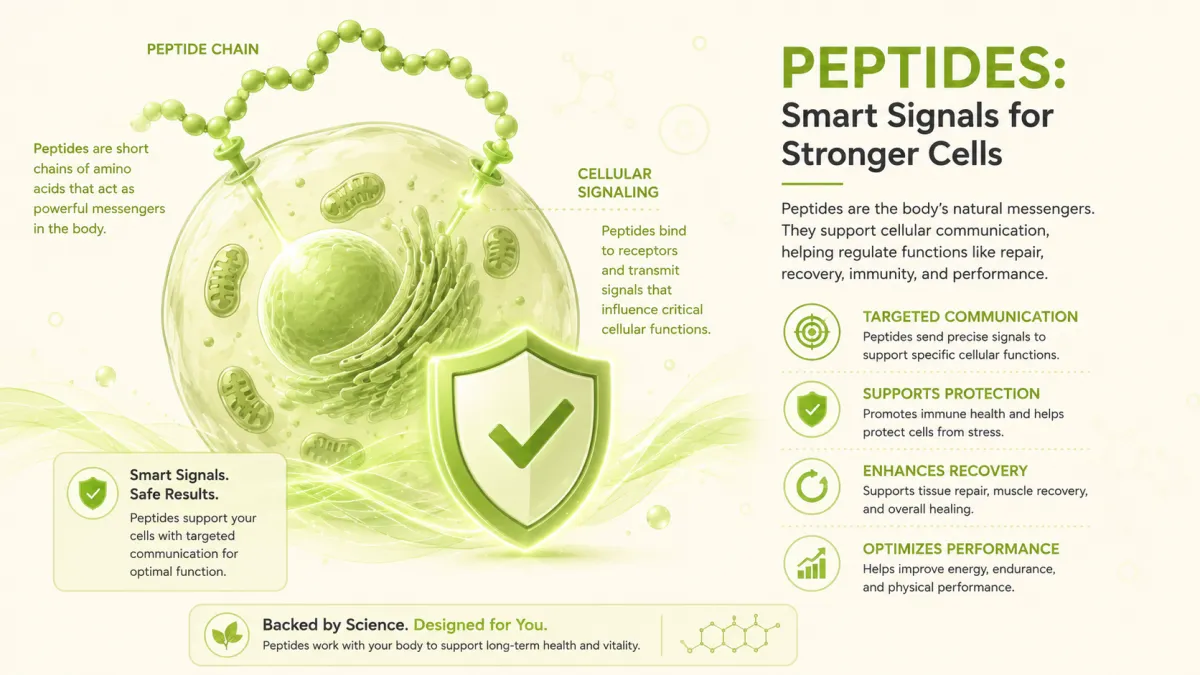
A peptide is a short chain of amino acids the building blocks of protein. Your body naturally produces thousands of peptides that act as signaling molecules, telling different parts of your body to perform specific functions . They can act as hormones, neurotransmitters, or even antimicrobial agents .
Some peptides are familiar medications. Insulin is a peptide. GLP-1s like semaglutide are peptides. These have been through rigorous clinical trials and are FDA-approved for treating conditions like diabetes and obesity .
But the peptides gaining popularity in wellness circles are different. These include BPC-157, TB-500, sermorelin, and GHK-Cu, among others. They are often promoted for tissue repair, muscle growth, recovery, and general optimization. The problem is that most lack large-scale human clinical trials to support these claims .
What Are Peptides Used For?
Peptide therapy is being used for a wide range of goals. Some of the most common include tissue repair and injury recovery, with peptides like BPC-157 and TB-500 often promoted for healing tendons, ligaments, and gut issues . Growth hormone stimulation is another use, with sermorelin and similar peptides intended to boost natural growth hormone production for muscle growth, fat loss, and better sleep . Energy and vitality are also targets, as some patients report increased energy and mental clarity on peptide protocols . Additionally, peptides are used for skin, hair, and collagen support GHK-Cu is a copper peptide popular for its potential skin and anti-aging benefits .
But it is important to understand that many of these uses are based on animal studies, lab data, or anecdotal reports not robust human clinical trials .
The Science: What We Know and What We Don't
Peptides have been studied for decades in specific contexts. For example, sermorelin was originally FDA-approved in 1997 to treat growth hormone deficiency in children, though it is no longer commercially available in the U.S. . Some peptides are being studied in clinical trials for specific conditions, but "research-grade" peptides are not the same as FDA-approved medications .
When you buy peptides from compounding pharmacies or online sources, they are often not FDA-approved for the use you intend. Many are considered "research-grade" and have not been evaluated for safety, effectiveness, or quality by the FDA .
The New Yorker recently investigated this growing industry, noting that many popular peptides "have little or no data for humans. They might have some interesting animal studies, or a theoretical reason to think they could work, but, for the purpose of clinical application in humans, that is basically meaningless" .
Risks and Safety Concerns
Contamination and Quality Issues
One of the most significant risks with peptide therapy is contamination. The market is often described as a "Wild West" . When a New Yorker writer ordered a peptide stack from an online supplier, lab testing revealed that one vial contained lead and another had endotoxins . Products purchased online may be impure, incorrectly dosed, or contaminated with bacteria or toxins .
In 2024, the FDA issued warnings about unsafe injectable products, and there have been reports of people becoming very sick after receiving injections from unregulated sources . A woman in New York died after receiving an NAD+ injection at a wellness center from someone accused of practicing medicine without a license .
Theoretical Cancer Risk
Because peptides can stimulate cellular growth and repair, there is a theoretical concern that they could also stimulate the growth of existing cancer cells. Experts warn that "since we're boosting cells, we'd want to make sure we're not boosting any aberrant cells or cells that shouldn't be there" . This is why cancer screening is sometimes recommended before starting peptide therapy.
Lack of Long-Term Safety Data
Most popular peptides have not been studied in large-scale, long-term human trials. This means the long-term effects including potential hormone imbalances, organ effects, or other health consequences are simply unknown . One expert described the risk as "the unknown" .
Side Effects
Common side effects can include injection site reactions, nausea, headaches, flushing, and dizziness . More serious side effects may occur depending on the specific peptide and dosage.
What Is Sermorelin and What Should You Know?
Sermorelin is one of the most popular peptides in wellness circles. It is a synthetic version of growth hormone-releasing hormone (GHRH) that stimulates the pituitary gland to produce more growth hormone . It was originally FDA-approved for children with growth hormone deficiency but is no longer commercially available in the U.S. .
Some people use sermorelin off-label for anti-aging, body composition, and sleep improvement . However, none of these supposed benefits have been proven in large human clinical trials . Importantly, sermorelin does not directly increase testosterone, despite some internet claims .
What to Check Before Starting Peptide Therapy
Work with a licensed provider. Peptides should be prescribed by a healthcare professional who can review your medical history, order appropriate lab work, and monitor your progress . The "gray market" is dangerous, and self-prescribing carries significant risks .
Check your sources. Always purchase peptides from reputable compounding pharmacies that meet FDA 503A or 503B regulations. Products from unregulated sources may be contaminated or incorrectly dosed .
Get baseline labs. A provider should check your biomarkers before you start and monitor them regularly to ensure safety and track effectiveness .
Address lifestyle first. Peptides should not be a shortcut for basic health habits. Experts recommend optimizing sleep, nutrition, and exercise first, and using peptides only as part of a broader health plan with a "clear, clinical rationale, not just because they're trending" .
Discuss cancer screening. Because of the theoretical risk of stimulating aberrant cells, a provider may recommend cancer screening before starting peptide therapy .
Understand what you are taking. Not all peptides are the same. Different peptides have different mechanisms, targets, and risks. Your provider should explain the specific peptide, its evidence base, and what to expect.